
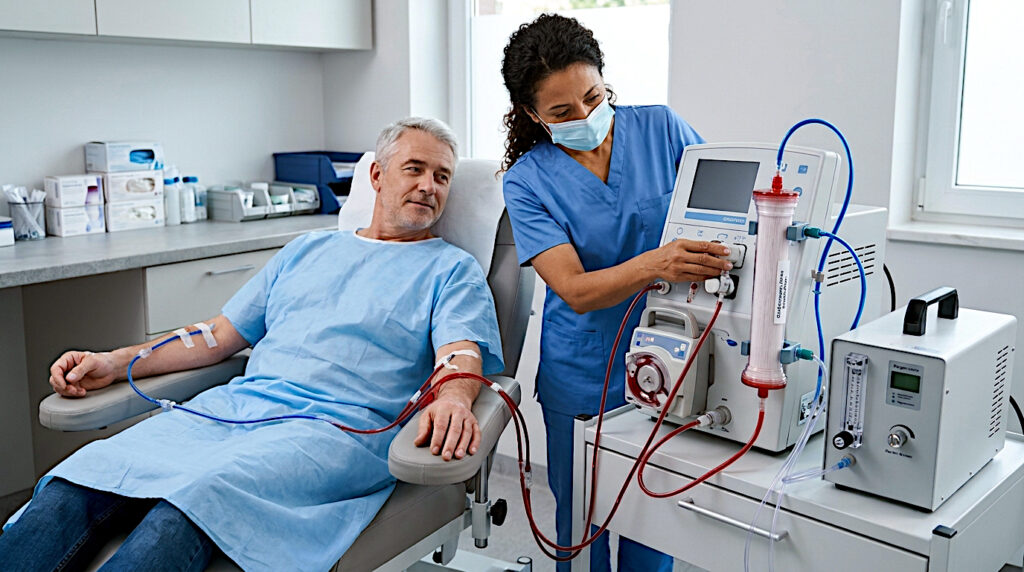
Extracorporeal Blood Oxygenation and Ozonation, usually shortened to EBOO, is an alternative medical procedure in which a large volume of a patient’s blood is drawn out of the body through a closed-loop circuit, exposed to a controlled mixture of medical-grade oxygen and ozone, and returned to the circulation in one continuous process.
It is the most intensive form of blood ozonation in use. Where classic Ozone Autohemotherapy treats a single bag of blood, EBOO cycles several liters through a gas exchanger in a single session.
How the procedure works
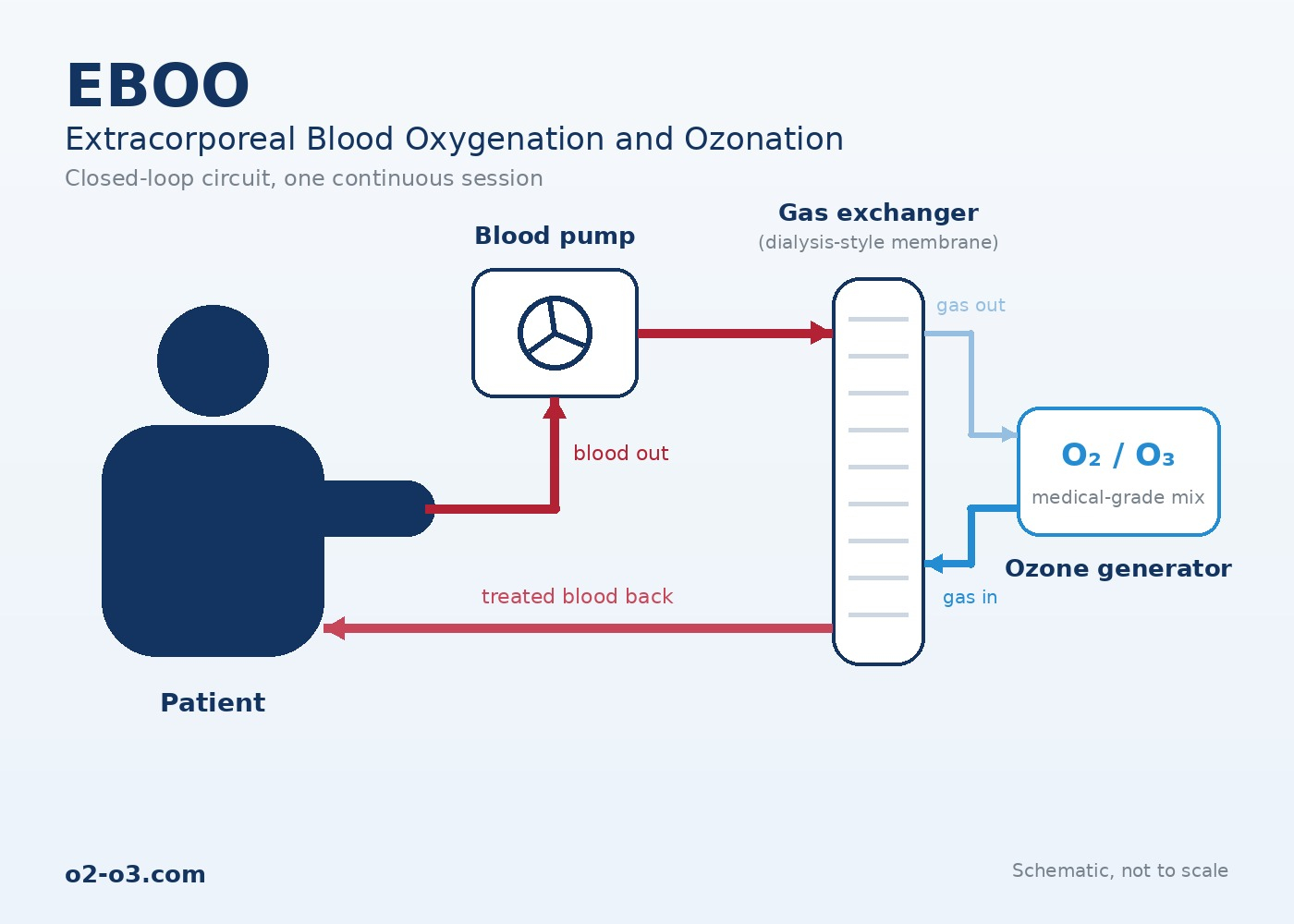
Blood extraction. A cannula is placed in a vein and a medical pump draws blood into an extracorporeal (outside the body) circuit. The blood is heparinized so it does not clot in the tubing.
Ozone exposure. The blood flows through a gas exchanger, in most modern setups a dialysis-style hollow-fiber filter, where it meets a low-concentration oxygen-ozone blend flowing in the opposite direction. The membrane keeps gas and blood apart while ozone and oxygen diffuse into the blood.
Reinfusion. The treated blood flows back into the patient through a second line. A session runs continuously for about 45 to 60 minutes.
Monitoring. Blood flow, gas concentration and the patient’s vital signs are watched throughout, as in any extracorporeal procedure.
How EBOO differs from other ozone blood treatments
Major autohemotherapy (MAH) draws a fixed amount of blood, usually 100 to 250 ml, mixes it with ozone in a bag or bottle and reinfuses it. The “10-pass” method repeats that cycle ten times under pressure in one appointment.
EBOO does not work in batches. The research group in Siena, Italy, that developed the technique reported treating up to 4,800 ml of blood in one hour of extracorporeal circulation, against about 250 ml with autohemotherapy, using an oxygen-ozone mixture of 0.5 to 1 µg of ozone per ml of oxygen. Their standard cycle was 14 one-hour sessions over 7 weeks (Di Paolo, Gaggiotti and Galli, Redox Report, 2005, https://pubmed.ncbi.nlm.nih.gov/16156950/).
A 2023 measurement study found that continuous countercurrent flow through a dialysis membrane, which the authors call ozone dialysis, delivers at least three times more ozone to the blood than any other blood ozonation method they compared (Rowen, Grabovac and Su, Medical Gas Research, 2023, https://pubmed.ncbi.nlm.nih.gov/36204785/).
What the published research shows
EBOO was developed over the 1990s by Nicola Di Paolo, Velio Bocci and colleagues at the University of Siena. The published record is small and comes mostly from that group.
- Preliminary report, 2000. The first human report described the apparatus and early treatments in patients with atherosclerotic vascular disease and Madelung disease, with no side effects observed (International Journal of Artificial Organs, https://pubmed.ncbi.nlm.nih.gov/10741810/).
- Necrotizing fasciitis case, 2002. A dialysis patient whose infection had not responded to standard treatment improved markedly after EBOO (https://pubmed.ncbi.nlm.nih.gov/12518965/).
- Controlled trial in peripheral artery disease, 2005. 28 patients were randomized to EBOO or intravenous prostacyclin. The EBOO group showed a highly significant regression of skin lesions, with better scores for pain, itching, heavy legs and well-being. Blood flow in the legs did not change in either group, which the authors took as a sign that EBOO acts through mechanisms other than improved circulation. No side effects or complications were recorded in 210 treatments (https://pubmed.ncbi.nlm.nih.gov/16288443/).
- Clinical overview, 2005. By then the group had performed more than 1,200 treatments in 82 patients, mainly for severe peripheral arterial disease, coronary disease, cholesterol embolism, severe dyslipidemia, Madelung disease and sudden deafness of vascular origin. After a session, markers of lipid oxidation in plasma rose four to five fold and plasma protein thiols fell proportionally, without measurable hemolysis, which the authors proposed as simple laboratory checks of the treatment’s biological effect (https://pubmed.ncbi.nlm.nih.gov/16156950/).
- Case report, 2025. An 88-year-old woman with chronic anemia and high urinary levels of mycotoxins and heavy metals had two series of three EBOO sessions; her urinary toxin levels fell by 26 to 65 percent on average, with no control for ongoing exposure (Cureus, https://pubmed.ncbi.nlm.nih.gov/41583215/).
Taken together, these are small randomized trials, case reports and the developers’ own clinical experience. There are no large multicenter trials, and the proposed mechanism, a controlled oxidative stress that modulates immune and endothelial cells, is still a hypothesis under study.
Safety and regulatory status
EBOO is an invasive procedure that needs venous access, anticoagulation, a pump, a sterile single-use circuit and trained staff. It belongs in a clinical setting with the same precautions as dialysis or apheresis. It is not something that can be done at home or with a tabletop ozone generator.
The Siena group reported no complications in the treatments it published. Even so, the regulatory picture is uneven across different countries. In the United States, EBOO is currently not an FDA-approved treatment for any condition. In Italy, Spain, Germany, and several other countries, Ozone Therapy is practiced in licensed clinics under national rules, and EBOO is offered by a limited number of them.
Learn more about Ozone Therapy at O2-O3 (https://o2-o3.com/en/category/ozone-therapy/),
browse our Ozone equipment (https://o2-o3.com/en/product-category/ozone/),
or contact us (https://o2-o3.com/en/contact/) with questions.
* This article provides general information and does not replace an individual medical assessment.