
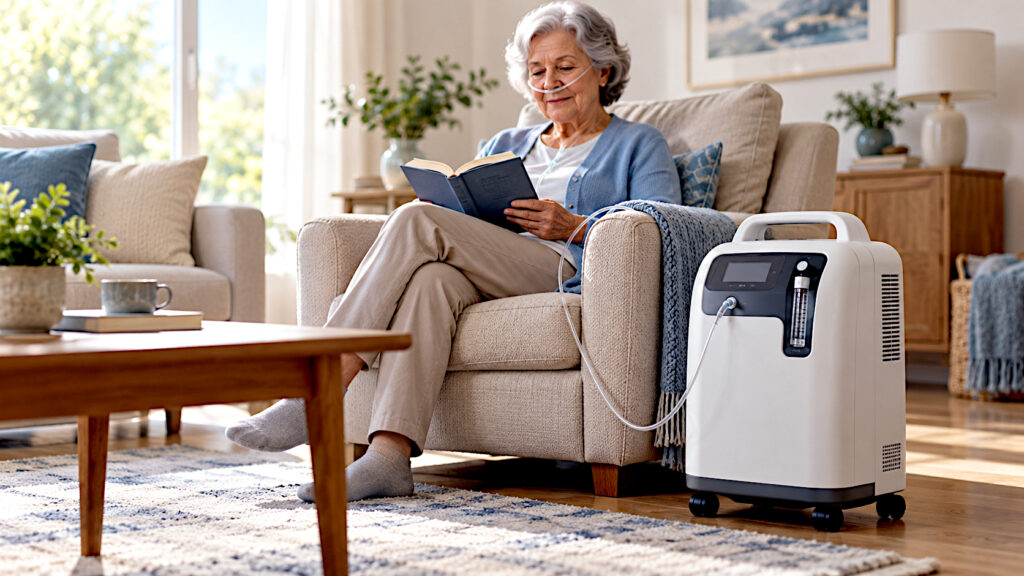
Choosing a Home Oxygen Concentrator means comparing more than prices and portability. The right equipment needs to deliver your prescribed oxygen reliably while fitting into your daily routine.
Understanding how oxygen therapy works—and what research actually supports—can help you ask better questions before buying.
When does Home Oxygen Therapy help?
Supplemental oxygen increases the oxygen available to people whose blood oxygen levels are too low, a condition called hypoxemia.
For people with chronic obstructive pulmonary disease (COPD) and severe, persistent hypoxemia at rest, long-term oxygen therapy has established survival benefits. The American Thoracic Society recommends its use for at least 15 hours daily in this group.
However, the benefits depend on the patient’s condition. The same guideline advises against routinely prescribing long-term oxygen for COPD with moderate resting hypoxemia. Oxygen used during activity may be appropriate for some patients with severe exertional desaturation, following clinical assessment.
This makes an accurate prescription the starting point for choosing equipment. Breathlessness alone does not establish how much oxygen someone needs.
How does an Oxygen Concentrator work?
An Oxygen Concentrator takes in surrounding air, separates out other gases, and supplies oxygen-enriched gas through tubing, usually connected to a nasal cannula.
Unlike a cylinder, which stores a finite supply, a concentrator produces oxygen-enriched gas while it operates. It needs electricity or battery power, so power availability matters when planning home use and trips outside.
Five things to check before buying

1. The prescribed delivery mode and flow
Confirm your requirements at rest, during activity, and while sleeping. These may differ.
Continuous flow delivers oxygen steadily, with flow expressed in liters per minute. Pulse-dose delivery supplies oxygen in bursts associated with inhalation.
These modes should not be treated as interchangeable. Ask your clinician or respiratory therapist to confirm that the specific device meets your needs in the situations where you intend to use it.
2. Oxygen concentration at the required setting
Request the manufacturer’s specifications for oxygen concentration across the machine’s operating range.
Check what the device delivers at your prescribed setting, rather than relying on a headline maximum-flow figure. Ask for the operating manual before purchasing and clarify any limitations on intended use.
3. Practical portability
Compare the complete carrying weight, including the battery and accessories. Ask how long the battery lasts at the setting you will actually use.
Consider your usual journeys: moving between rooms, visiting family, attending appointments, or spending several hours outdoors. Ask the supplier to explain charging options and whether additional batteries are available.
4. Everyday usability and support
A machine that suits your routine should also be straightforward to operate and maintain.
Before ordering, ask about:
– Noise levels and where the unit can be positioned.
– Cleaning and filter maintenance.
– Alarms and what each warning means.
– Warranty coverage, servicing, and replacement parts.
– Training for you and anyone helping with your care.
The American Thoracic Society recommends equipment and safety education for patients and caregivers as part of home oxygen provision.
5. A backup plan
Ask your care team what to do during a power outage or equipment failure. Depending on your needs, this may include an alternative oxygen supply.
Have a clear plan before relying on a concentrator at home, particularly if you need oxygen for long periods. Backup arrangements also appear in manufacturer documentation for prescription concentrators.
Research update: is more oxygen time always better?
A 2024 randomized trial published in the New England Journal of Medicine compared oxygen prescribed for 24 hours daily with oxygen prescribed for 15 hours daily in 241 patients starting treatment for severe, chronic resting hypoxemia.
Over one year, the 24-hour regimen did not produce a lower risk of hospitalization or death than the 15-hour regimen.
The finding adds useful evidence about treatment duration, but it does not establish that every patient can safely reduce their oxygen use. It also does not compare oxygen therapy with no treatment.
For patients, it provides a reason to discuss treatment duration at a clinical review. Continue following your individual prescription unless your healthcare professional changes it.
Monitoring supports treatment decisions
A fingertip pulse oximeter can help monitor oxygen saturation, but its readings have limitations. The FDA advises considering symptoms alongside the displayed number and contacting a healthcare professional about concerning readings or worsening symptoms.
Ask your care team for your target range and instructions for responding to unexpected results.
Find equipment that fits your prescription and your life
A useful buying decision starts with three questions:
- What oxygen delivery do I need?
- Can this device provide it?
- Will it work reliably in my daily routine?
Once your clinical requirements are clear, you can compare equipment with greater confidence.
Explore Oxygen Concentrators at O2-O3 (https://o2-o3.com/en/oxygen/oxygen-concentrators/),
or contact us (https://o2-o3.com/en/contact/) with questions about product specifications, accessories, and availability.
* This article provides general information and does not replace an individual medical assessment or oxygen prescription.